You've probably heard the term "AI agent" a lot lately. Maybe from a podcast, a LinkedIn post, or a vendor trying to sell you something. The trouble is, the phrase gets thrown around so loosely that it's lost most of its meaning.
So here's what an AI agent actually is, how it differs from the workflow automation you might already be using, and, honestly, whether your business needs one right now.
The difference between automation and AI agents
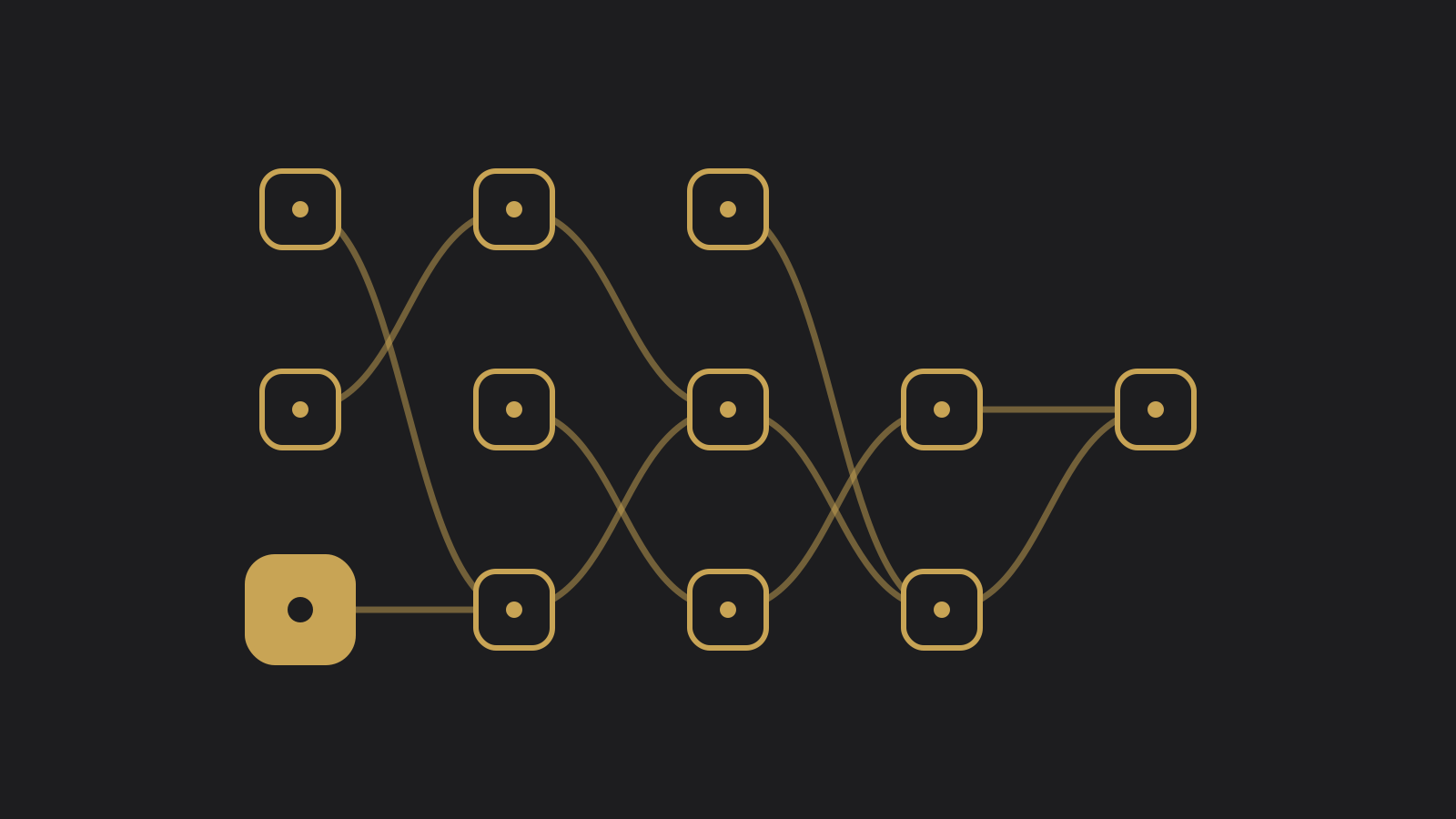
Standard automation is rule-based. It follows a fixed path: if X happens, do Y. That's it. There's no flexibility, no judgement. The system does exactly what you told it to do, every single time.
That's actually a strength in a lot of situations. Rules-based automation is fast, reliable, and predictable. If a new invoice arrives, send it to your accounting software. If a form is submitted, add the contact to your CRM. No surprises.
An AI agent works differently. Instead of following a fixed script, it can read a situation, consider a few options, and choose the most appropriate path. It can handle exceptions. It can ask for more information. It can decide that something is outside its scope and pass it to a human.
In short: automation follows rules. An AI agent makes decisions.
A simple example
Let's say someone submits a contact form on your website. Here's how each approach handles it.
Traditional automation: New form submission received: send a confirmation email. Done. The system doesn't know or care what the person wrote, who they are, or what they need.
An AI agent: New form submission received. The agent reads the message. It checks whether this looks like a serious business enquiry, a support question, or a general curiosity. Based on that, it either books a discovery call into the calendar, sends a tailored information pack, or flags it for a human to review because the request is ambiguous. All of this happens without anyone touching it.
Same trigger. Completely different outcome quality.
What AI agents can do for your business
The use cases that work best are ones where the volume is high but the decisions are relatively well-defined. Things like:
- Routing decisions. Sorting incoming enquiries, support tickets, or leads into the right bucket, and sending them to the right person or system.
- Drafting responses. Reading an email or message and generating a first draft reply for a human to review and send, based on context from your previous conversations or documents.
- Categorising incoming requests. Tagging support tickets by topic, urgency, or customer type so your team doesn't have to do it manually.
- Summarising information from multiple sources. Pulling together notes from a CRM, a call transcript, and a previous email thread into a one-paragraph briefing before a meeting.
- Escalating when confidence is low. Knowing when not to act. A well-built agent will pause and ask for human input rather than guess wrong.
The value tends to compound in businesses that have a lot of repetitive decision-making baked into their day: customer-facing roles, operations, or anything with high inbox volume.
What AI agents still can't do well
It's worth being clear here, because a lot of vendor marketing isn't.
- Nuanced relationship decisions. An agent can't read the full history of a complicated client relationship and know that this particular person needs to be handled with care. Not reliably, anyway.
- High-stakes judgements without human review. Anything where being wrong has real consequences (legal, financial, reputational) still needs a human in the loop. Agents can prepare the information, but they shouldn't be the final decision-maker.
- Tasks with no clear success criteria. If you can't describe what "good" looks like, an agent can't optimise for it. Vague instructions produce vague results.
The honest version: agents are better than most vendors admit at routine decisions, and worse than most vendors admit at anything that requires real judgement or empathy.
Do you need an AI agent or just good automation?
Most businesses don't need AI agents yet. That's not a popular thing to say, but it's true.
If your processes are messy, your data is inconsistent, and your team doesn't have reliable systems in place, adding an AI agent on top will just make things faster and messier. The automation equivalent of putting a turbocharger on a car with broken suspension.
Start with solid workflow automation. Map your most repetitive processes. Remove the manual handoffs that don't need to be manual. Get your tools talking to each other. That alone will save you real time and give you a much clearer picture of where decisions are actually happening.
Agents add meaningful value when two things are true:
- You have a high volume of incoming requests or tasks.
- Those tasks require different responses depending on context. Exceptions are frequent, not rare.
If you have 10 new leads a week, a simple automation works fine. If you have 200, and each one needs a slightly different response based on industry, company size, or what they asked about, that's when an agent starts to earn its keep.
Where Workvolve fits in
We're a Brisbane-based AI automation agency, and we work with businesses across Australia. We build both standard workflow automations and AI agent systems, and we'll tell you honestly which one you actually need.
We're not here to sell you the most sophisticated thing. We're here to save your team time in a way that lasts. That usually means starting with the fundamentals: clean automations that handle the predictable stuff, so your team only touches what genuinely needs human attention.
If your business is at the stage where exceptions are starting to pile up and the rules aren't covering them anymore, that's the conversation where agents come in. We'll help you work out which category you're in before we build anything.
Every build is fixed-price, and you get a firm date in writing before we start. No lengthy discovery phases, no open-ended retainers.
If you're not sure where to start, book a free 30-minute strategy call. We'll ask you a few questions, get a clear picture of what your day actually looks like, and tell you plainly what would make the biggest difference.